






In this blogpost:
What Happens to Your Dopamine During a Cold Plunge?
Explore how cold exposure may affect dopamine, alertness, mood and focus, and understand what the science really tells you about cold water immersion.

You step into cold water and suddenly everything feels sharper.
Your breathing changes. Your attention narrows. You feel awake.
Dopamine is often given the credit for that experience.
There is genuine science behind the neurological response to cold exposure, but the story is more complicated than simply saying that a cold plunge “boosts dopamine.”
Your brain responds to cold through several overlapping pathways, and dopamine is only one part of the picture.
What Does Dopamine Actually Do?
Dopamine is a neurotransmitter involved in motivation, reward, movement, learning, attention, and goal-directed behaviour.
It is often described as the brain's “feel-good” chemical, but that description is misleading.
Dopamine is not simply about feeling happy.
It helps your brain assign importance to experiences and influences motivation and behaviour.
That makes it relevant when considering why a challenging experience like cold exposure can leave you feeling energised afterwards.
Cold Activates Your Nervous System
The first response to cold is immediate.
Cold receptors in your skin send signals to your nervous system. Sympathetic activity increases, your breathing can accelerate, and your body enters a heightened state of alertness.
Norepinephrine is particularly important during this response.
That alone can help explain why cold exposure feels stimulating.
You are not simply sitting in cold water. Your entire nervous system is responding to a sudden environmental challenge.
Where Does Dopamine Come In?
Cold-water immersion is popular for post-exercise soreness. A Cochrane review of 17 trials involving 366 participants found reduced muscle soreness for up to 96 hours compared with passive recovery, although study protocols varied.
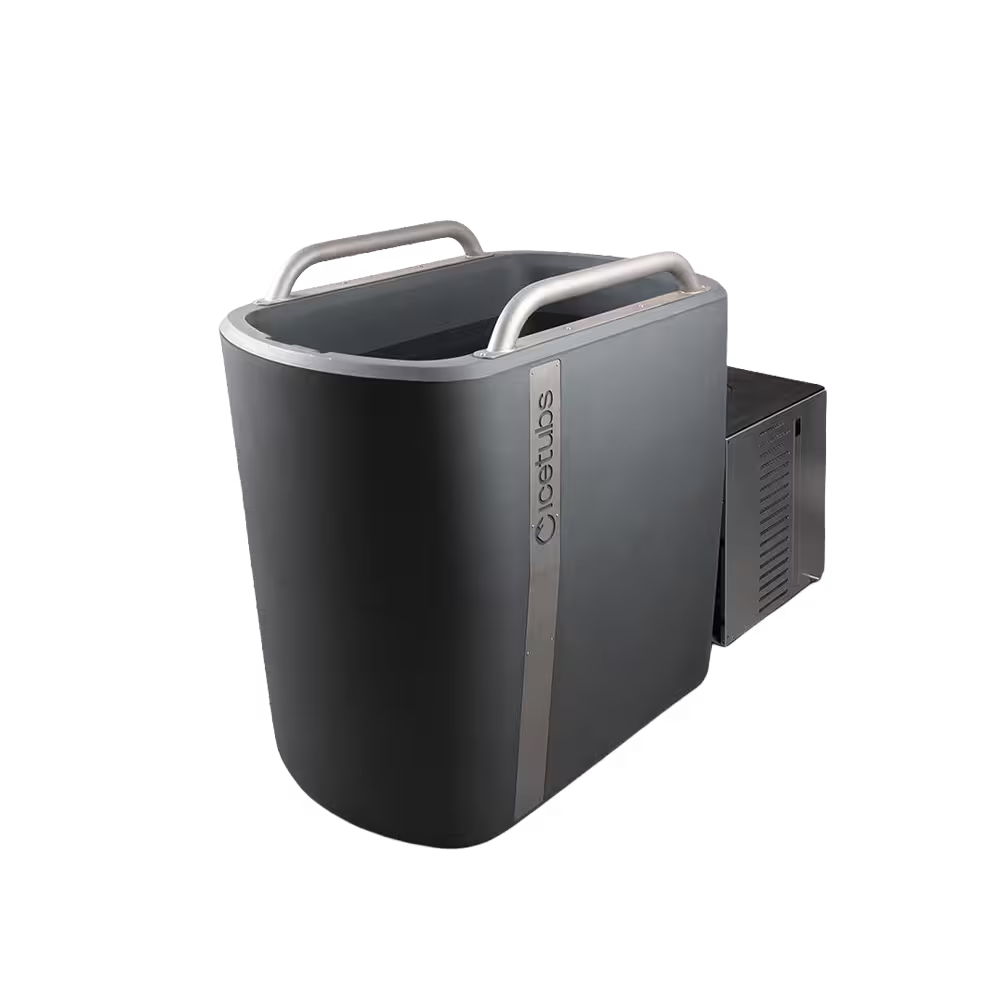
Icetubs incorporates controlled cold exposure into a routine designed around consistent temperature and repeatability, while its cold therapy approach also connects the experience with alertness, energy, and mental clarity.
The exact magnitude of a dopamine response should be treated carefully, however.
A specific percentage from one exposure protocol should not be interpreted as a guaranteed increase every time you enter cold water.
Temperature, duration, individual physiology, and the way dopamine is measured all matter.
Why Can You Feel So Alert Afterwards?
The post-plunge feeling is probably the result of several mechanisms working together.
Cold stimulates sensory nerves. Sympathetic nervous system activity rises. Norepinephrine increases. Your attention becomes focused on your breathing and the immediate physical sensation.
That combination creates a very different mental state from sitting quietly or scrolling through your phone.
There is also a behavioural component.
You deliberately enter an uncomfortable environment, regulate your breathing, stay present, and finish the session.
That can create a strong sense of accomplishment.
Does Cold Improve Mood?
There is growing interest in the relationship between cold exposure and mood.
Some research suggests that cold-water exposure can influence mood-related pathways, while many people report feeling more energised or mentally clear after a session.
But cold plunging should not be presented as a treatment for depression, anxiety, or other mental health conditions.
A cold plunge can be part of a broader wellness routine.
It should not replace professional care when that is needed.
Dopamine Is Not the Whole Story
The most interesting part of cold exposure may actually be how many systems respond simultaneously.
Your circulation changes. Your breathing changes. Your body begins producing heat. Your sympathetic nervous system becomes more active.
Neurotransmitters and hormones are part of this larger response.
That is why reducing the entire experience to dopamine misses much of what is actually happening.
The Goal Is Not to Chase a Chemical Spike
You do not need to chase the biggest possible dopamine response.
The more useful goal is creating a sustainable practice.
With consistent temperature control and a repeatable routine, you can learn how different levels of cold affect your own energy, focus, and comfort.
The value is not necessarily in one dramatic session.
It is in understanding your response over time.
For the broader physiological story behind the nervous system, metabolism, circulation, and hormones, explore The Science of Cold Exposure: How It Affects Your Body